Connecting, Sharing, Learning, and Growing Just Got Better at The Lab!

Professional Development Updates and More

Things are already heating up for 2023 and we still have some wonderful sessions coming up in 2022!

Make sure to join us for the following workshops.

Remember that as Members of The Interpreter’s Lab you are automatically registered in the ALL workshops.

September

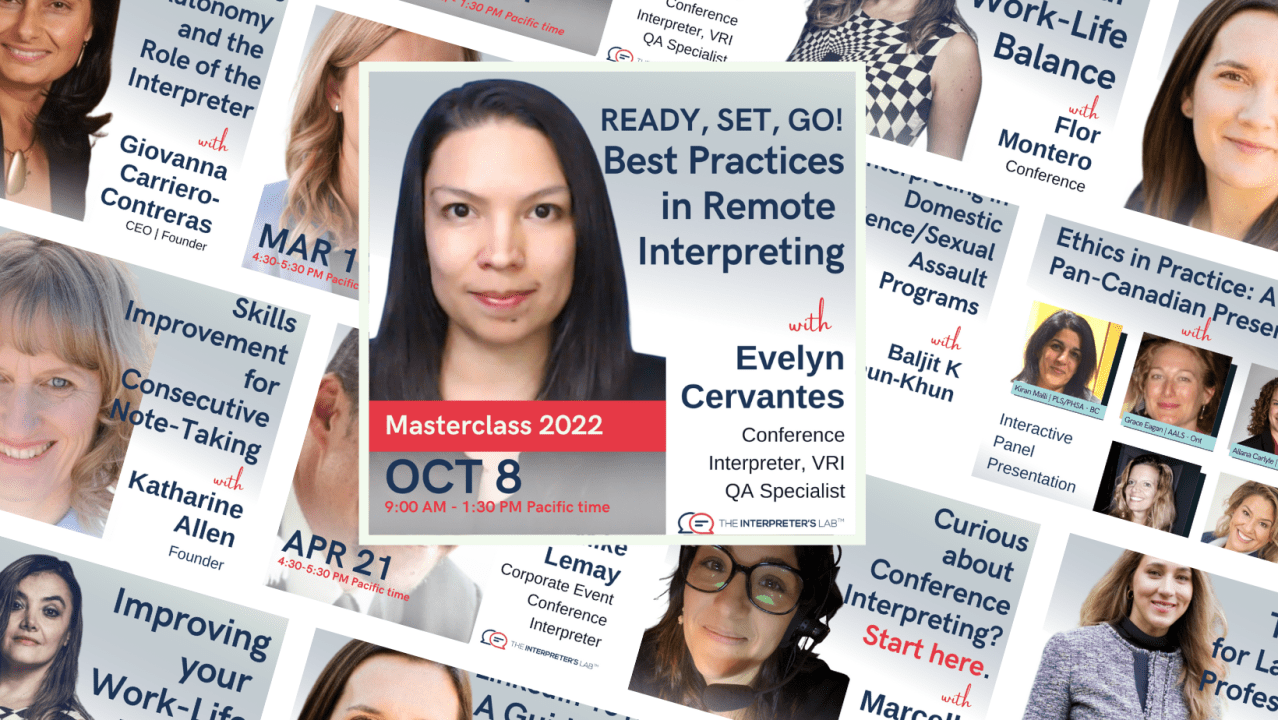
On September 15th, the wonderful Katherine Allen will be presenting, and teaching, Skills Improvement for Consecutive Note-Taking. This special 2-hour workshop is free to all Members of The Interpreter’s Lab. If you would like to invite a friend to attend, they can register online HERE.

October

On October 20th, Baljit Khun-Khun, a nurse with BC’s Women’s Hospital Sexual Assault Program, will speak on Interpreting for Women’s Sexual Assault Programs. This can be a particularly challenging and sensitive setting for interpreters.

November – Final Workshop of 2022

On November 17th we bring you the final session of the 2022 series, and it is a special one – a Pan-Canadian Panel Discussion on Ethics in Practice with the leaders of 4 of Canada’s largest community and healthcare-based language service providers:

  • Kiran Malli – The Provincial Health Services Authority
  • Allana Carlyle – Winnipeg Regional Health Authority (soon to be a part of Manitoba’s Provincial Health Authority)
  • Jane Langes – E-Quality Communication Centre of Excellence – in Winnipeg
  • Grace Eagan – Access Alliance Multicultural Health & Community Services / RIOMIX

I am so grateful to these wonderful women to take the time to come and talk to our members. It will truly be an important dialogue.

The 2022 Masterclass in on October 8th. Members can join for only $44 – that is a $205 discount. But you must register to participate. You can REGISTER HERE using the coupon code you’ve been given for the $205 savings.
The 2023 Speakers Series

Coming in the new year – each workshop at The Lab is eligible, hour for hour, for PDUs / CEUs with CTTIC member bodies and OCCI (Ontario only)

January                        The Function and Role of Questioning in Legal Settings

February                      Understanding Pain Descriptors in Medical Settings

March                           Tax Strategies for Freelancers – What’s New for 2022

April                             Using Standards to Push the Advocacy Agenda (ISO)

May                              Interpreters and Healthcare Practitioners in Dialogue: Interactive Panel

June                              The Challenges of Non-Binary Language in Community Interpreting

July                               Demand Control Schema – A Model for Ethics and Self Care

August                          Interpreting – Transferable Skills to Open New Opportunities

September                   Terminology: Best Practices for Interpreters

October                        TBA

November                    TBA

Masterclass                  TBA

If you have any other suggestions for topics, or speakers, or perhaps you have a favourite from 2021 or this year who you would enjoy learning from again – we would love to hear your ideas as we continue to put this schedule together.

Find Out More About Membership


Members Only Updates

Small group discussion coming to the Monthly Workshops
After 6-months in the current format, we are implementing improvements to Member benefits. One of the biggest complaints I hear from our students and members, and interpreters in general, is that the work can be isolating. Frequently interpreters do not have a place to connect on a more personal, or individual level. While our monthly workshops are amazing (given all the wonderful speakers and topics) the member-only portion of our time together could be improved. So, we will be introducing small group discussions so that we can better share and connect.

After the speaker has completed their hour or designated time (sometimes it is a longer session), we will break into small groups of 4-5 to share and discuss. To keep things efficient, each group will be assigned a facilitator/moderator (timekeeper) and a reporter (to take brief notes) to share with the large group. These roles will be volunteers from the group.

At times, it might make sense to break off into same language groups, or at other times it may be totally fine to stay in the large group. At The Lab we are responsive to your needs.

Goal

  • To provide a forum for interpreters to share and learn from each other in a safe space
  • To provide a space to debrief about challenging situations (ethics/difficult customers or clients/ working conditions, etc.)

Quarterly Cycle (months of occurrences): October, January, April, July

Dates:

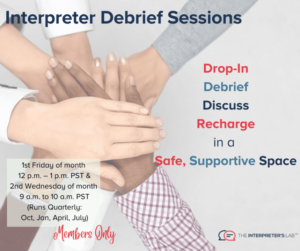
1st Friday of the month 12 p.m. – 1 p.m.  PST

2nd Wednesday of the month 9 a.m. to 10 a.m. PST

Schedule and process will be provided through your member portal and you can sign up for one of the session in the months of occurrence)

Process:

  1. Small groups created in Zoom
  2. Moderator and Reporter are assigned (volunteers will be selected from the Members in attendance)
  3. Breakout rooms open and small groups divide
  4. Small groups share for 15 mins
  5. Large group sharing highlights for 15 mins

Why is the format changing?

The format is changing slightly to allow for more equal participation and discussion. Not everyone is comfortable speaking in a large group. The Lab is intended to be a safe, non-judgemental space for interpreters, and we hope that this small change will facilitate networking and discussion.

What if I can’t stay, will I still get a Certificate of Attendance?

If you usually time your participation around the speaker’s presentation and have other commitments, that’s ok! If you are in attendance for the topic and the speaker, then you will get your certificate. Of course, we would love to have you stay for the full time, but we understand that life is busy.

See you in September with Katharine Allen and remember to check into your Community Hub for more updates and latest information

Angela and the TIL Team 

The Secret Key: How Working as an Interpreter Unlocks Access to Different Worlds

In a previous blog post, on Why being an interpreter is a good career move for foreign trained health care professionals, I wrote that interpreting in healthcare settings is a smart professional career move for health care professionals who were trained outside of Canada, and it’s true! It is a smart move, not just for foreign trained professionals, but for anyone who is interested in a deeper, closer look into the systems that provide all our public services.

While community interpreters, those who work in community-based settings such as healthcare, legal, social services, and even courts, may not enjoy the bonus of early morning executive breakfast meetings, or touring famous sites with delegations, or even enjoying a free buffet lunch at conferences as conference or diplomatic interpreters might, the role does come with definite perks. An often-unrecognized benefit of working as an interpreter is the privilege of access to forbidden places – settings where the common citizen, unless personally affected, is unlikely to go, such as operating rooms, prisons, psychiatric wards, judges’ chambers, etc.  While these places may not be glamorous or thrilling, the education they offer is undeniable. To be present, to witness (as a participant) how the events unfold, the protocols required, the ways in which the parties communicate with each other, the relationships and expectations involved – these nuggets of information and experience can never be learned in a classroom.

Becoming an interpreter provides a view into a professional realm that is often reserved for the professionals who work within. An interpreter, as a language professional, comes to share that space in their role as language and communication mediator, and comes to learn the inner workings of so many varied and unique places.

“I think the course is great and I highly recommend it. It opens doors for you. And if you are afraid with how everything works with agencies, this will explain a lot for you. You will have more confidence.”

Mayra

Spanish | English Interpreter

In my earlier blog post on healthcare interpreting, I stated that, “the post-secondary education – the lessons and courses taken – to become a healthcare professional are taught as a formal program, but it is often the unspoken and informal that is most difficult to learn. There are no lesson plans for that, and the few intercultural or cross-cultural workshops that exist may still not provide in-the-field experience. The education of understanding a new system, creating new networks, observing how people interact with each other and with patients, that is an education that is best gained by doing”. This practical observation applies across professional and occupational roles.

Being bilingual or multilingual is a talent that we share with close to 60% of the worlds’ population but utilizing that talent, by gaining the education and training and working as an interpreter, launches that talent into something that not only brings you an income, but also gives you a view into other worlds.  That insight–that valuable exposure–can bring you a return that you may never have even imagined.

Join us for a short-term course that packs a great big return!

See our Course Schedule here

In closing I leave you with the words of another Interpreter’s Lab student:

“I’m always very keen to learn new stuff. I wanted to see what’s in it – because I already knew English and Punjabi – what are the things that they’re going to teach me that I don’t know about?  But once I got into it, then I found out the little I did know…. then you know how much you don’t know – interpretation, going into community settings, or health settings or legal settings… all the valuable vocabulary, there’s so much behind the scenes that you learn in such a little time. It’s just night and day.”

Nick

Punjabi | Hindi | English Interpreter

Spring into Knowledge and Grow your Practice

Curiosity is a valuable trait in interpreters, and one that is commonly associated with those interpreters that excel at their work. Curiosity leads to the pursuit of answers, answers lead to gains in knowledge, and knowledge, in turn, becomes the ingredient that transforms a good interpreter into a notable interpreter.

At The Interpreter’s Lab we know that an interpreter needs to not only pay attention to professional development, that is, the fundamentals of professional skills and information, but that interpreters must also pay close attention to the marketplace and business growth, as well as taking good care of their personal and emotional wellbeing. The factors that make interpreting so appealing and fascinating are the very factors that oblige us to know more and do better. Factors such as the rapidly evolving marketplace, the dynamic interactions that form our work, and the interesting push and pull towards exploring the evolution of their field and their career. It may even include adventuring into the world of translation work, or other aligned occupations.

It has been clearly demonstrated and felt most intensely by the arrival of COVID19 and the simultaneous decrease in on-site appointments, that remote interpreting is here to stay and grow. This applies to Remote Simultaneous Interpreting (RSI), as well as Remote Consecutive Interpreting. What does this mean for interpreters’ professional and career development? With the spreading utilization of remote platforms comes an expansion of the marketplace, in both demand AND supply – more work, more competition. But competition is good. It keeps us alert and focussed, even though it may require us to learn new skills or nurture existing ones.

At The Lab’s monthly Professional Development Speakers Series this past month (April 2022), our guest speaker, Mike Lemay, demonstrated just how essential confidence and an adventurous attitude are in growing your practice and presence. Mike shared how he went from volunteering as an interpreter at his church (which he still does, voluntarily), to interpreting at a UN conference. Now that is inspiring! Confidence is critical, and confidence is cultivated through knowledge, practice, and exposure to new ideas. The participants were inspired by Mike’s presentation!

“Thank you, Mike, for all the information and encouragement.” Gurveen

“Thank you very much!! Amazing session enjoyed it a lot!!” Maria

“Excellent presentation and looking forward to connecting again” Jennifer

So, what are the skills, knowledge, and tools that I believe will help future-facing interpreters?

  1. Working with technology, in all its various forms, is a critical skill set for interpreters – remote settings, online platforms, gear to get you started and keep you working (headsets, microphones, etc.), as well as familiarity with agencies and contract negotiation.
  2. Embracing social media skills to keep your profile in view and to grow your opportunities – including the conventions and etiquettes that work best.
  3. Building community and embracing competition. (It’s not a bad word at all!). By working together we all work better – it’s true! One thing the interpreting community needs to do is shed its proclivity for silos and embrace unity. Join your community at The Lab

Be curious about your interpreting world, ask questions. Dive in and gain skills and knowledge. See where the adventure will take you. And let The Interpreter’s Lab help you along the way.

Get Social Media Working For You

Join us on April 21 and May 19 and get your social media working for you!

Two back-to-back guest speakers that will get you started on the right path.

I must admit it, I am not the most consistent person when it comes to social media. In fact, days could go by when it comes to checking my Instagram or LinkedIn accounts. And literally weeks can pass before I open Facebook or Twitter. It’s not that I have any sort of aversion to social media, it’s quite honestly because I’d rather be doing other things. And on one hand, that is a healthy way to be about social media (if you’ve not yet seen the film The Social Dilemma, I highly recommend you do). Studies have shown the detrimental effect that social media can have on our mental health and well-being. But the reality is also that social media can be a good thing. It helps us stay connected to family and friends around the corner and around the globe, it exposes us to new ideas, products, or services and it can create a community and a feeling of belonging for many people. The point being that we need to use social media, not allow social media to use us.

But for small business owners, like me and you, social media is an absolute necessity. Small business owners, including solopreneurs like freelance interpreters, benefit greatly from social media. It is a free way to advertise yourself and put your brand and best self out there. If you want to grow, connect, and cultivate new clients, then social media is a must.

But is it as easy as just putting up a picture, or a quote or liking someone else’s post? It is not. Social media done right can expand your world and your place in it. Social media done incorrectly can be a waste of your time or can even hurt your public profile. And of course, as interpreters working for a variety of agencies, and for a variety of clients and professionals, we have great responsibility. We must protect and maintain confidentiality, we are to be respectful of our colleagues and, moreover, we should channel support for our profession by always bringing forward the positive.

This year at The Interpreter’s Lab, we bring you two back-to-back sessions (April and May) that will give useful tips, tools, and guidance on how to put yourself out there and grow your business. On April 21, Mike Lemay will present on Social Media as a Marketing Tool and in May Madalena Sánchez Zampaulo speaks to us about LinkedIn 101 – A Guide for Interpreters. LinkedIn is one of the best platforms for professionals, so an important part of your social media skill set.

You can find out more about each of our speakers before you join us by checking out their social media in advance. And come ready for some questions for these two wonderful speakers.

Mike Lemay:  Mike the Interpreter

Madalena Sánchez Zampaulo: M|Z

How to Join:

  • If you are a TIL Member, you will automatically be sent the Zoom login for the session.
  • If you are not a member, and would like to simply register for one or both of these sessions, you can do by going to The Interpreter’s Lab HERE

Links:

The Social Dilemma: Social Media and Your Mental Health https://www.mcleanhospital.org/essential/it-or-not-social-medias-affecting-your-mental-health

Social Media and Mental Health: https://www.helpguide.org/articles/mental-health/social-media-and-mental-health.htm

The Social Dilemma (on Netflix)

Our Humanity is our Strength: Navigating Emotionally Charged Settings

Image: Inside Edition News: https://www.insideedition.com/emotions-are-high-as-interpreter-breaks-down-translating-zelenskyys-speech-ukraine-activist-73545

Mauro Couto

Interpreting demands a high level of accuracy and well-developed time management skills. To perform with precision, the interpreter needs to be fully focused on the task at hand. Hearing the client’s speech, reading their body language, catching intonation, being mindful of all the details involved in communication; then processing this collected information and reproducing it in a different language, transposing their client’s complex expression, through cultural and linguistic barriers, to land safely on the other side with an accurate version, just to start again. This requires rational thought, drive and concentration.

“the fact that interpreters often work in emotionally sensitive situations creates challenges”

Emotional intelligence is essential for performing rationally and achieving those desired results. The interpreter needs to be able to identify their client’s emotions, as well as their own, to then reproduce them appropriately. If the interpreter fails to understand and control their own emotions, harnessing them to their advantage, they risk losing focus and the task may be compromised.

But interpreters are only human and humans are moved by emotions. Maybe one day the profession will be taken over by cold AI-driven software. Until then, the fact that interpreters often work in emotionally sensitive situations creates challenges in this activity. These challenges are, however, not fully undesirable, as they are a by-product of what most motivates interpreters to do their job: the perception of how meaningful their activity is to the people involved, of how much their work impacts their clients’ lives.

This obstacle will eventually arise in any environment in which an interpreter works. In a legal setting, the interpreter will likely face anxiety-laden formal situations more often, while a healthcare interpreter may frequently work with patients who are going through significant personal distress, sometimes informing them of serious diagnoses, but in a more informal and caring environment. Conference interpreting will usually have a less emotionally sensitive setting, with the interpreter striving to develop their emotional intelligence to ground and to stay focused in the moment for greater lengths of time and with fewer interruptions. Nonetheless, conference interpreters are also often exposed to extreme emotional challenges.

On February 27th, 2022, Nadiya Kyrylenko, a veteran interpreter for the German news outlet Welt, had been assigned to interpret a speech by Ukraine’s president Volodymyr Zelensky live from Kyiv. Three days earlier, Russia had invaded Ukraine, and Mr. Zelensky was now leading his country’s defence and struggling to secure meaningful support from Ukraine’s allies in his nation’s fight for self-determination against a formidable invading force.

The urgency of the matter, the bravery shown by a young leader in military uniform supplicating for assistance for his people, as well as the terrifying realization that the darkness of war was descending over that free nation and of all the suffering that would ensue, created a setting that proved too emotionally dense for the interpreter to maintain her focus and do her job. She interrupted her delivery, cried during the live broadcast, and apologized as she struggled to conquer back her concentration to continue.

As an Interpreter, Ms. Kyrylenko failed at her task that February 27th. Due to significant emotional distress, she was not able to properly interpret Mr. Zelensky’s speech, as it had been expected of her. To anyone who was listening to his speech through her voice, however, her failure was perfectly justified. In fact, in a way, it may have enriched the circumstance. As Russian tanks coldly and mercilessly rolled into Ukraine and the invaded nation pleaded for help from its peers, Ms. Kyrylenko’s failure has already gone down in history as an admirable and defiant expression of humanity.

About the contributing writer:

Mauro Couto is an international Law graduate from Brazil who has had experience practicing Law in his home country since 2006. Mauro has worked as an interpreter with a Vancouver based, non-profit organization providing mental health services to survivors of torture.

Related Links of Interest:

We have linked some articles that may be of interest below:

The Road to Equity is Paved by Trained Interpreters

I recently came across an article I had written, together with a colleague, for Cultures West Magazine – an AMSSA* (Affiliation of Multicultural Societies and Service Agencies of B.C.) newsletter in 2006. The article, titled Accessible Health Care: A Response Framework for a Culturally Evolving Community was on the subject of strategies for how the healthcare system could improve its outreach to and inclusion of all members of our diverse community. Reading the article started me thinking how the more things change, the more they stay the same.

My entry into language services came from my passion for social justice and equity. For many years, I worked in intercultural communication, anti-discrimination and anti-racism as a project leader, facilitator, researcher and consultant. I was led to this work in the late 1980’s, after having volunteering overseas in South America and became passionate about the issues it involved. It was during my time at MOSAIC as the interpreting services manager that I soon realized how important language truly is in its role as a gateway to equity, justice, and most importantly, to the formation of a cohesive society. You simply cannot have cohesion and a common ground without access to a common language.

In a multicultural and multilingual society, interpreters are the agents of change – not just anyone who is bilingual, but trained and knowledgeable interpreters who are beholden to a common ethical framework, set standard of practice and core competencies to do the work they are trained to do. They are the links that form a society of individuals who can successfully communicate, engage, be heard and fully share all the benefits a nation awards onto its population. Without interpreters, we become a disjointed community, lacking the tools to fully connect.

I may sound a little dramatic (blame it on my Neapolitan heritage), but I believe this to be true. Language can bridge a massive divide that for many, if left as a gulf between client and service provider can, at the extreme, be the difference between life and death or, more commonly, have severe negative impacts on one’s quality of life.

I want to acknowledge that utilizing interpreters does not absolve professionals who serve within a diverse community of the responsibility to consistently practice cultural humility. While professional interpreting services have always been a crucial core component of any access plan, interpreters cannot single-handedly fix the discrimination and racism that exists in Canada. And so more work is always needed.

In going back to the article in AMSSA’s Cultures West magazine which provoked me to write this post, my colleague and I listed 3 fundamental considerations that are critical to the success of a healthcare system in multilingual and multicultural society: these are accessibility, cultural responsiveness and comprehensiveness. These 3 essential factors could never be fully implemented without the inclusion of trained and educated interpreters. Because language is the gateway to inclusion.

I believe that the reason the more things change, the more they stay the same is because reaching the goal of an equitable society is rarely fully achieved, and therefore we continue in our efforts. However, in continuing to work toward this goal, we succeed in making changes that matter and which transform our society for the better.

*To read the original article in Cultures West go HERE

*To find out more about AMSSA  https://www.amssa.org/

The Interpreter’s Lab Report – Fall 2020

In Gratitude… a special offer just for you.

Calling all past students – take the Interpreting in Community Settings course, get refreshed, get your continuing education units done, and pay only $197 (that’s a $300 savings!)*

Register NOW

Coupon code randr2020 (note – returning TIL students only)

What a year it has been.

To say it has been a tough or challenging year is an understatement. From our personal lives to our workday lives, I imagine that most of us have felt the impact of all that this year has sent our way and felt it on many levels.

It is said that when external conditions force adjustment upon us, it is best to contemplate the positive instead of dwelling in the negative. I do not offer this observation lightly: as some of our students know, we here at The Interpreter’s Lab have been touched by loss and sadness in our own personal lives in recent months and so to consider the light rather than the dark is advice that we have also been following.

The quiet time that resulted as a change to everyone’s schedules allowed the team at The Interpreter’s Lab to review and reflect on our own programs and offerings.
Moving to an online learning organization was something that we had planned several years ago, not ever foreseeing the events of this year and how the move to online teaching was a fortunate chain of actions given the pandemic response.

When we first shifted our courses to the online blended learning, some of our students hesitated to join a virtual course, fearing that the technology would be too confusing, that there would be no interaction with other students, and other concerns. But once they actually participated in a class, they could not stop saying how much better online is!

Because we want you all to know just how much better online can be, from now until December 31, 2020, previous TIL students can sign on to our Interpreting in Community Settings Course – online – for only $197 (that is a $300 savings!) – less than $6 per hour for expert content and instruction.

Not only do you get to experience the online environment, you also get:

  • An opportunity to take a refresher/update on your skills
  • Learn new content – our courses are continuously being updated with the best and latest resources and information
  • Learn how to navigate an online environment (useful if you have made or are making the shift to remote interpreting)
  • Receive an actual Certificate of Completion as all of our courses now include a final exam

Think of it as an opportunity to take a refresher course for 1/3 of the price.

“People of different backgrounds and experience come together to learn and share. Comfortable learning environment to learn community interpreting. Practical knowledge, case studies and videos that give me a clearer picture of how interpreting world is like as it is hard to understand without examples. I enjoy this online class; it saves me so much traveling time. And it’s actually better than I expected how an online course would be. Being able to interact with everybody online is a plus.”
Student – Interpreting in Healthcare Settings, Spring 2019

The Interpreter’s Lab has been providing interpreter education since 2012. In 2019 all of our programs were fully online which means that for 7 years we delivered our courses in a real, live, physical classroom. The shift to online, blended teaching was done once we realized how much better it could be for our students for multiple reasons:

  • More content and resources for students
  • Longer duration/time for students to access course content
  • Multiple instructors
  • Opportunity to watch the recorded lessons if a student misses a class or if they just want to re-watch the lesson

Not to mention no driving or taking public transit, no parking, and no extra costs and time.

So, in this time of change, and as many of you may have some extra time and energy, we want to extend a special offer to all our former students that have taken a course with The Interpreter’s Lab prior to 2018. This is for all those students that participated in a traditional, physical classroom and that have never taken an online course with us.

…Interested?
The next course start September 8, 2020. Register NOW

…Not ready or too soon?
Then register for our October** course.

USE COUPON CODE randr2020 to get your $300 discount*

As long as you take any one of the 2 Interpreting in Community Settings courses available before December 31, 2020 you qualify for the reduced fee.

*NOTE: This offer is only for returning students that have not yet taken an online course with The Interpreter’s Lab.
** NOTE: The Interpreter’s Lab reserves the right to make schedule changes as required. It is recommended to register for the September course to avoid any disappointment should the October course be rescheduled to 2021


IMPORTANT NOTICE: Changes to our course schedule

This fall, The Interpreter’s Lab will be undergoing an organizational improvement plan.

We hope to build, and offer, improved courses and programs for our clients and students, and an improved student experience.

To take full advantage of this opportunity, we have decided to limit the number of courses being offered in fall 2020.

What this may mean for you:

  • Only 1 to 2 sessions of Interpreting in Community Settings* will be offered (September and October).
  • There will be NO Interpreting in Healthcare Settings course offered in fall 2020**
  • The Interpreting in Mental Health Settings course will not be offered again until fall 2021. We encourage students to take advantage of this course offering at this time to not delay your training.

We apologize if these schedule changes cause any inconvenience but we know that ultimately you, our students and clients, will benefit from these improvements.

*NOTE: we strongly encourage people to register for the September 8th course as we may reschedule the October session to 2021
**NOTE: If you wish to take the Interpreting in Healthcare Settings this year, please email us to be added to the wait-list

Stayed tuned for an even better Interpreter’s Lab!

An Interview with Kiran Malli, the Director of The Provincial Language Service* of the PHSA of British Columbia

* The PLS is a program of the Provincial Health Services Authority of British Columbia. Find out more about Kiran Malli at the end of this blog post.


Hello Kiran and thank you for taking the time to answer a few questions.
Hello Angela, not a problem at all. In fact, it is my pleasure.

Q. Kiran, Can you tell me a bit about the service you provide at PLS?

A. As you know, the PLS is the only provincial interpreter services program in Canada and what makes us more unique is the fact that we are a part of BC’s health care system. That means that our standard of service has to meet a high threshold for quality and efficiency. I believe it is imperative that PLS encourages interpreters to acquire the skills and education that is necessary to achieve a certain competency.

Q. Why do you think it is important for interpreters to have training specifically in working in healthcare settings?

A. The importance of using professional, vetted and qualified interpreters in health care cannot be understated. They are essential tools in the delivery of appropriate and accessible health care. The skills involved in interpreting go far beyond those of speaking two or more languages. Just as having two legs doesn’t make one a marathon runner, having two languages doesn’t make one an interpreter. To finish a marathon, training is required, and certain techniques are learned, employed and perfected through the training process. Similarly, a professional interpreter possesses learned skills that are developed and perfected through training. The cognitive process of interpreting can indeed be as grueling as a marathon run.

Q. What do you look for when recruiting interpreters for the PLS?

A. We look for people who are trained, have proven language proficiency in their language pairing and have interpreting experience.

Q. From your experiences, how is the work of interpreters trained to work in healthcare settings different than that of an interpreter without that specialized training and education?

A. A health care encounter is, more often than not, a collaborative encounter in which everyone is on the side of the patient or client getting well. Interpreters with health care training are more confident in their role and fully understand the context and the possible dynamics at play. A trained health care interpreter will know when it is appropriate to sight translate material (patient education material) and when it is not (consent documents). They will understand that sometimes providing cultural context is necessary to achieve positive health outcomes and ensure patient safety. For example, when a health care provider instructs a patient to take medication after every meal, the health care provider is coming from a Canadian context of three meals a day, whereas the patient may be from a cultural context in which tea time is consider a meal and therefore may take the mediation four times a day. A cultural frame must be provided.

Q. What is the feedback you hear from healthcare professionals in terms of the quality of interpreting?

A. Health care providers often comment on the high quality of our interpreters. They have said that PLS interpreters are professional and an important tool in ensuring appropriate and effective patient care. HCP’s are also quick to point when an interpreter does not meet the expected standard. It is important to note that the quality of an interpreter does come through in every encounter.

Q. What are your views on specialized training for mental health settings or complex care situations?

A. Interpreters that work in mental health are especially challenged to ensure that the message is accurately and faithfully transmitted. This is for many reasons, least of which is the significant role that culture plays in concepts of mental health, mental illness and stigma. In addition to that, mental health issues and the system of care are a complex maze of interactive conditions and factors. At PLS we strive to only assign mental health appointments to interpreters that have taken the effort to gain that extra education and training. It makes a big difference both for the client, the family and the mental health care professional.

Well, we would like to thank you once again for giving us a few minutes of your time and hope that we can talk again in the future.

I would love to join you again. Thank you.


Kiran Malli has worked in the area of improving access to health care for people with limited English proficiency since 1996. Over that time, Ms. Malli has developed and implemented interpreting service programs within various health care institutions and health regions across the Metro Vancouver and Fraser Valley regions of British Columbia, Canada.  Kiran is currently in her second, 3-year term as a member of the Board of Directors with Critical Link International.

Kiran Malli believes that meaningful access to health care begins with the ability to effectively communicate with the health care provider. She is a strong advocate for equitable access to care which ties to her experience in the field of anti-racism, diversity, and access. She is an established curriculum developer and facilitator/trainer.

Kiran has been training community interpreters in various aspects since 1996. She has extensive experience developing training modules to suit organizational and group needs and a strong background in program planning and development.

Bottlenecked and Backlogged: Eventually the Demand for Interpreters’ Services will Explode

I may be wrong, but the way I see it is that you can only delay and deflect for so long.  At some point it will all come bubbling up. Since the COVID-19 pandemic really hit home here in Canada, interpreters have seen unprecedented numbers of cancelled, postponed or rescheduled appointments. Interpreters, along with many others, have had their livelihoods snatched from under their feet. But when life gets back to some form of normal, not only will many of these previous appointments re-emerge with clients and public services in need of interpreters, but the need will inevitably be greater than before.

More cases, more need, and more demand.

Interpreters will become even more essential to the fabric of Canadian society.

When we start to come out of our homes and cautiously resume our activities, those areas that were most critical – justice, health care, mental health, and education – will be the first to resume. And there will be more on the horizon.

While the news coverage these days seems to be almost entirely about COVID-19, and understandably so, life continues in the background. Many people will continue to struggle in areas including health, finances, substance abuse, violence, and legal issues; many of these are probably intensifying due to the disruptions that COVID-19 has brought to our lives, as we have had to socially distance ourselves from one another and adapt to new isolated lifestyles.

Although the demand for interpreting services may currently be low, once the pandemic restrictions are lifted, demand will return, and in all likelihood, be even greater than before.

I applaud the provincial and federal governments’ efforts to provide interpreting services for the ASL community. It is important that community members not only get the information they need, but that they also feel the same sense of community support and connection that those of us who speak English or French do.

In Saskatchewan, ASL services were provided only once the community sent in email requests for them to do so (‘I felt so included’: Sask. interpreter communicating COVID-19 information to deaf community, CBC News)

“I feel so included” 

Patricia Spicer, Deaf and Hard of Hearing Services, Saskatchewan

Indeed, a sense of inclusion is especially critical in times of crisis. However, the very real need for information is also important – it is crucial for us in fighting and recovering from the pandemic. Lack of accurate information, or lack of access to that information, can lead to other complications and concerns:

“For me to get the information in my own language, it was a huge relief. I knew that I had to stay home. I knew I should wash my hands regularly.

I knew what to do. Without that I would still be worrying.” (CBC news)

Canada is home to people that speak  65 indigenous languages and dialects, and nearly 200 non-official languages. And we know that there is a struggle to get critical information to those populations that are excluded by language barriers.

To address this, the City of Calgary has set up an amazing Multilingual Resources Page that I highly encourage everyone to visit and to share among community members.

Sometimes simply finding the information for those that do not speak English or French, or face other communication access difficulties, is often challenging.

The resources that some of us take for granted, or assume as obligatory and common – internet, WIFI, phones, laptops, etc. – are not universally available. Moreover, going to see your doctor, or even to a walk-in clinic is a changing reality for many across Canada, with many clinics moving to ‘virtual-care’ services. Virtual services play an important role in supporting social distancing; however, they can exclude clients if adequate language access has not been provided.

Many organizations are now feeling this gap in services – a gap which was a pre-existing problem now highlighted by the pandemic.

Newcomers to Canada may not have the same reserves as those who have been here for some time. Health and other concerns can only be ignored so long. For some individuals and their families, staying in place can be a dangerous and unhealthy proposition.

Given the precarious subsistence of some families and individuals, stress can exacerbate an already difficult reality. Courts across the country have been put on hold, and prisons across the country are seeing increasing cases of COVID-19.  Even the IRB has suspended all in-person hearings.

The extensive list of services and businesses experiencing temporary closures and reduced activity has affected a  range of sectors: settlement services, education, justice, health, mental health, businesses, child-care, employment, financial services, and transportation have all been touched.

In my assessment, one of the many lessons that this pandemic world is teaching us is the importance of human outreach and connection, especially when we have been deprived of them.

It has been said that interpreters are the glue that hold a multilingual society together.

For once society emerges from this shared yet isolating experience, and people move through the bottlenecks and backlogs, interpreters’ services will be even more vital and in greater demand.

Some good things to do to turn downtime into SMART time:

Volunteer your language skills

  • Read – books for learning and for pleasure.
    • Check out and follow the #1ntbookreferrals on Instagram for recommendations from other interpreters – (Thank you to Mike Lemay/@miketheinterpreter for tip)

A Simultaneous Shift: Expand your skills. Boost your career. Get ahead of the demand

Skate to where the puck is going, not where it has been.” – Wayne Gretsky

Simultaneous Interpreting workshop and professional development for interpreters that work primarily in consecutive mode.

The line between consecutive and simultaneous modes of interpreting are regularly being blurred. Though community interpreting has traditionally been taught and perceived as being primarily or exclusively consecutive interpreting, the reality is that community-based interpreters frequently find themselves in situations that call for simultaneous mode. [i]

Much anecdotal evidence exists where interpreters are given an assignment and, without warning or notice, will be asked to interpret in simultaneous mode. Perhaps, during a class or presentation, an interpreter is requested to sit with the client among a group of English speaking clients and whisper the translation of what is being said (also known as chuchotage) or, also common, they are expected to instantly switch from consecutive to simultaneous mode, mid-stream, or, as I’ve heard, interpreters are sometimes even expected to interpret along to a video being shown, in real time, like a human ‘sub-titler’.

When an interpreter finds themselves in such a situation, they might attempt simultaneous, and they might do well enough, but without the knowledge, proper training and practice, is one really achieving competency? Is the rendition accurate and faithful to the message?

Consecutive and simultaneous interpreting modes draw differently from the interpreter’s set of skills and abilities.

While consecutive interpreting relies heavily on an excellent working memory (aided by note taking), the simultaneous mode instead, demands a more urgent conversion of meaning. Both skill sets require education and practice. And both skills sets should be developed, and enhanced, by interpreters working in all settings.

Given today’s global crisis with COVID-19, but also more broadly the global shift to more frequent utilization of remote interpreting, many interpreters may be considering expanding their skills and incorporating simultaneous as something that they can offer. Or maybe it’s not even about expanding work opportunities, but simply improving competencies for the current situation.

Complementing your toolkit of services is always a good idea, and, as many of our students know, something that we, at The Interpreter’s Lab, always encourage.

Sometimes fear gets in the way of our professional growth.

We think we are not good enough or capable of doing something that we have watched experts master.

But we all have to start somewhere and exiting our comfort zones is where real growth happens.

As Wayne Gretsky once said, “skate to where the puck is going, not where it has been.

Simultaneous interpreting is not simply confined to the booth any longer (and really, was it ever?) and, as a fellow interpreter comments, “the conventional image of court or conference interpreter doing only simultaneous, while community interpreters work exclusively in consecutive mode is like a false dichotomy — they’re not as neatly disparate as that.”

Acquiring the knowledge and skills to perform in simultaneous mode as effectively as in consecutive mode gives interpreters more than the obvious additional abilities and greater competency, it also boosts confidence – regardless of the setting.

And so, we invite you to:

START YOUR JOURNEY TO SIMULTANEOUS INTERPRETING

Join us on April 16th and April 23rd for a unique workshop:

Simultaneous Interpreting: Out of the Booth and in the Community.

This unique professional development workshop is designed with interpreters that work primarily in consecutive mode in mind.

Below is a short blog written by our Program Coordinator – Annike Andre-Barrett – on her reflections of working in simultaneous mode from the perspective of an interpreter working primarily in consecutive.

On Simultaneous Interpreting from the Perspective of Consecutive Practice

Consecutive interpreting is like playing catch and simultaneous interpreting is like juggling.”  – Annike Andre-Barrett

In sports broadcasting, a sports commentator gives us play-by-play commentary of a game in real-time.

In other words, they narrate the game. In the case of radio commentary, the listeners cannot see what is going on, and the commentators try to convey the action on the field in words as quickly as it happens. Both the game and the commentary are being broadcast live. The commentator cannot pause the game in order to take note of the moves and then summarize them to the listeners, nor will the players stop to allow the commentators to catch up. The commentators must therefore keep up with each significant detail and ensure their listeners have all the key information to be able to visualize and follow the game.

I’m not really a sports spectator myself, but I thought of this as a fitting analogy for interpreting, specifically the art of simultaneous interpreting. Radio commentary makes more sense in this comparison, because visual language is a communication system in itself – not being able to see the game is like not having access to a particular language. As such, the commentator is like an interpreter, converting visual into spoken language.  And the play-by-play nature of the commentator’s coverage can be thought of as simultaneous interpreting.

When it comes to my own lived experiences as an interpreter, I may be biased, but I find simultaneous interpreting to be even more exciting and engaging than watching one’s favourite sport. It doesn’t matter what the subject matter is, the urgency of the challenge to deliver the message AND keep up is highly stimulating.  In simultaneous mode, the brain is trying to dynamically distribute the cognitive efforts or functions of listening, analysis, short-term memory and target speech production (source: Inside the Brain of a Simultaneous Interpreter, Literally). To me, it feels like mental gymnastics.  Or better yet, if consecutive interpreting is like playing catch, then simultaneous interpreting is like juggling.

Watch A Formula for Success in Simultaneous Interpreting – Professor Chikako Tsuruta – Tokyo University of Foreign Studies


[i] Sometimes this happens because those that work with interpreters (professionals and others) lack an understanding of the interpreter’s work and role.