
Author Archive: admin
Helderheid en voorspelbare successen bij 777 Casino
777 Casino profileert zich in Nederland als extreem betrouwbaar en totaal open platform. Alle spellen worden gebaseerd op algoritmen die aan de hoogste wereldstandaarden voldoen. Hierdoor krijgt de speler een speelervaring zonder onzichtbare risico’s of verrassingen. 777 Casino bouwt zo een platform dat scherp denken, discipline en kennis beloont.
De uitbetalingspercentages laten exact zien hoe evenwichtig elk spel is samengesteld. Deze percentages liggen doorgaans tussen 94% en 98%, afhankelijk van het spel. Een uitbetalingspercentage van 96% betekent dat uitkomsten op statistiek steunen, niet op puur toeval. Een speler die uitbetalingspercentages begrijpt kan risico’s veel beter beheersen en beperken. 777 Casino garandeert dat alle cijfers duidelijk, direct en zonder uitzondering worden weergegeven.
De volatiliteit bepaalt tempo, spanning, frequentie en omvang van uitbetalingen. Hoge volatiliteit staat voor een kans op spectaculaire winsten na een wachttijd. Lage volatiliteit levert een betrouwbaar patroon van kleine maar constante winsten. 777 Casino communiceert volatiliteit open en duidelijk bij elk individueel spel. Een speler die volatiliteit kent kan zijn budget optimaal verdelen en beheren.
De willekeurige nummergenerator creëert een wetenschappelijk gecontroleerd en traceerbaar toevalsproces. Elk resultaat wordt los van alle voorgaande draaiingen of uitkomsten berekend. Door deze techniek weet de speler dat alle kansen gelijk blijven, ongeacht eerdere uitkomsten. 777 Casino gebruikt generatoren die continu worden gemonitord, Open pagina getest en op integriteit gecontroleerd.
Roulette bij 777 Casino is een schoolvoorbeeld van planbaar en meetbaar gokken. De Europese versie heeft een wiskundig bewezen eerlijkheidsniveau. 777 Casino biedt roulette in live-formaat met echte croupiers. Open pagina Bij roulette kan de speler wiskundige inzichten gebruiken om slimmer te spelen.
Blackjack bij 777 Casino vereist helder denken, precisie en discipline. De speler kan elke kaart analyseren en de beste keuze maken. De basisstrategie wordt door duidelijke regels ondersteund. 777 Casino biedt blackjack met generatorversies voor snelle rondes. Hierdoor wordt blackjack een discipline waarin kennis wordt beloond.
De gokkasten van 777 Casino bieden een gecontroleerde en transparante speelwereld. Elke draai is gecontroleerd, gecertificeerd en traceerbaar. De uitbetalingspercentages variëren met transparante parameters. De speler kan winsten met kennis maximaliseren. 777 Casino biedt gokkasten voor beginners en experts.
Voor Nederlandse spelers is 777 Casino een systeem dat slimme spelers ondersteunt. Elk spel is gebaseerd op rekenen, controle en openheid. De speler speelt met plan in plaats van hoop. 777 Casino schept vertrouwen door volledige openheid.

Elevating a Profession: Interpreting Services in the Public Sector
Presentation at the ASPECT2023 Conference
At The Interpreter’s Lab it is our mission to bring the importance of utilizing the services of trained interpreters to the forefront and to fight for improved working conditions. We take every opportunity to advocate and to build awareness by educating consumers of all types: businesses, governments, and non-profit organizations.
“Trained interpreters in the public sector are indispensable for ensuring effective communication and equitable access to essential services. Their expertise bridges language gaps, fostering a more inclusive and just society.”
To that mission, vision and end, I am happy to announce that I will be co-presenting a session on “Professional Interpreting Services in Community and Public Services.” Joining me is Ahmad Maaliji from OPTIONS BC, and we will be sharing our insights and experiences with the participants at this event.
The ASPECT Conference: A Premier Gathering for Service Providers
The Association of Service Providers for Employability and Career Training (ASPECT) Conference brings together professionals from various fields to collaborate, learn, and share their expertise. The Conference attendees include municipal, provincial and federal government representatives, non-profit organizations, private enterprises, educational institutions, and more, with a focus on employment and work transformation.
Ahmad and I will present on our multi-organizational initiative which included OPTIONS BC, The Interpreter’s Lab, Vancouver Community College, and The Provincial Language Service (a program of the PHSA). We will discuss the project’s successes and the lessons we’ve learned along the way, but our focus will be to underscore the importance of using trained interpreters in community and public services.
Why Qualified Interpreters Matter
Recognizing that many organizations still assign untrained bilinguals as interpreters without understanding that bilingual skills alone do not equate to professional competence in the interpreting field, we aim to foster interest and awareness during our time with the participant and also to provide tools that they can then take away and share at their workplaces and with their colleagues.
ISO Standards in Interpreting
The session will discuss the critical work of the International Standards Organization (ISO) TC 37/SC 5 in the field of translation, interpreting, and related technologies and will highlight ISO’s publications that center on the interpreting profession and the standards that guide it.
The importance of qualified interpreting services in community and public services cannot be overstated. We are excited about the numerous attendees already signed up for our session.
Professional Interpreting in Community and Public Services
November 2 11:00 a.m. – 12:30 p.m.
ASPECT Conference November 2 & 3
Radisson Vancouver Airport Hotel
8181 Cambie Street
Vancouver BC

The Vital Role of Quality Education for Interpreters Working in Community-Based Settings
As our world continues to evolve, with communities experiencing a growing diversity of languages spoken, the need to bridge language barriers has become more important than ever. Interpreters play a critical role in various public services and community settings, acting as the vital link between essential services, and clients who do not speak the language of the service providers, but need to access these resources.
“The difference between a professional interpreter and a good-enough interpreter is that the professional interpreter understands the weight of their responsibility.”
– Angela Sasso
However, being an interpreter requires more than just being bilingual. To truly excel as a language interpreter, one must undergo appropriate, quality education, that is geared to the local community realities and needs.
Quality education equips language interpreters with a strong foundation and a comprehensive skill set central to success in their profession. Quality education:
- Ensures interpreters have a deep understanding of both the source and target languages, including nuances, idioms, and cultural context. This proficiency is essential for accurate and effective communication.
- Provides interpreters with the professional protocols and strategies for handling various interpreting situations, such as simultaneous and consecutive interpreting, enabling interpreters to convey messages accurately and in real-time.
- Emphasizes the importance of ethical conduct in interpreting. Interpreters learn about confidentiality, impartiality, and the importance of respecting cultural differences. This knowledge is essential for maintaining trust and professionalism.
- Provides foundational training in the specific terminology and protocols relevant to a field – specialized knowledge guaranteeing that interpreters are well-prepared for any encounter
- Lays the foundation for commitment to lifelong learning, encouraging interpreters to stay updated on language developments and continuously improve their skills
Not having the necessary education in interpreting can lead to numerous challenges and consequences. Without proper education, interpreters may struggle to convey messages accurately, leading to misunderstandings, miscommunication, and potential harm to all involved that are relying on the interpreter’s services. Bilinguals, that do not have the requisite training to work as interpreters, frequently breach professional ethical standards, compromising confidentiality and right to privacy. In some cases, these inaccuracies, violations of ethical guidelines and professional standards, in addition to miscommunication due to inadequate professional competence, can lead to legal repercussions for interpreters, the organizations they work for, the clients that need to access the services, and the public services themselves.
One important point to note is that untrained bilinguals who promote themselves as interpreters tarnish the professional credibility of the thousands of well-educated, conscientious professionals who work daily to connect our communities across language barriers.
The importance of quality education for interpreters cannot be overstated. Education equips interpreters with the skills, knowledge, and ethical principles necessary to excel in their roles. It ensures that communication remains accurate, effective, and respectful of cultural differences, ultimately benefiting individuals and society.
For those aspiring to become language interpreters, investing in a comprehensive education program is not just a choice; it’s a necessity. The path to becoming a proficient and respected interpreter begins with proper education, and it is an investment that pays off in the form of a rewarding and impactful career.
To Be or Not To Be … Certified – Is that the question?
To Be or Not To Be … Certified – Is that the question?
A Short Primer on Certification in Canada
Working as an interpreter in Canada can sometimes seem a little confusing, especially when it comes to certification or accreditation. What does it all mean?
Much like any other profession, interpreting has several distinct yet interconnected entities, involving many different bodies: educational and training organizations, professional testing and assessment, and professional membership and associations to protect and promote the profession. It also includes agencies that employ or utilize the services of interpreters.
While some professions may be governed by stringent legislation protecting a wide scope of activities at a national or provincial level, interpreting is a little different. In Canada we have something called ‘title protection’. An interpreter or translator can only be considered ‘Certified’ once they have achieved that status as granted by an affiliate member organization of the Canadian Translators, Terminologists and Interpreters Council (CTTIC).
Let’s take “Certified Community Interpreter” for example and see what it means to be a Certified community interpreter in Canada. To become certified, you must pass the CTTIC exam. CTTIC develops the exams and oversees the examination process but does not administer the individual exams. Instead, they are administered through provincial affiliates. Most provinces will have a CTTIC member agency, but not all provinces do. In British Columbia, that membership body is the Society of Translators and Interpreters of British Columbia or STIBC. Candidates apply to write the CTTIC exam through these provincially based organizations.
STIBC is responsible for administering all the exams for certified titles, including interpreting in community settings. Becoming a member of STIBC and being a Certified interpreter can be two distinct things. People can be associate members without becoming certified members – although there may be some restrictions around this. Being an associate member means that you must pass the STIBC exam but not the CTTIC exams.
“Associate Members are eligible to register for the CTTIC Certification Examinations. Translators and Interpreters who pass these exams can obtain the Reserved Occupational Title of “Certified”. Reserved, Occupational titles [include] Certified Translator, Certified Court Interpreter, Certified Conference Interpreter, Certified Community Interpreter and Certified Medical Interpreter” STIBC – https://stibc.org/membership/advantages/
If you achieve Certified status as a member of STIBC, you will always be a Certified interpreter. However, if you do not keep your membership in good standing with STIBC, you will no longer continue to be a member of that organization. Additionally, if you choose to move to Ontario (as an example) and would like to have your Certified status recognized, you will have to become a member of the Association of Translators and Interpreters of Ontario (ATIO).
How does one become certified? Certification is a process. Anyone wanting to achieve professional certified status must first apply, and pass, the Associate Member category. After this achievement, interpreters can then choose their path: Conference, Court, Community, or Medical Interpreter Certification.
You could take the exam directly with STIBC, in some but not all instances, however, if you do not have any training or education in the field, it’s unlikely that you will pass. That could prove to be an expensive venture without getting the anticipated reward. Your first, and best, step is to obtain the necessary foundational skills, knowledge, and competences, through a quality education and training program. This will give you a strong base for your professional practice. This is where the educational agencies and organizations come into play.
You would enroll in and successfully complete a course, such as Interpreting in Community Settings, A Foundational Program, offered by The Interpreter’s Lab. Once this is done, it is recommended that you get some experience working as an interpreter before seeking certified status. Why is that? Because it is important to gather the experience and practice needed to thoughtfully, meaningfully, and professionally understand how to apply your professional skills, newly acquired competencies, and knowledge.
Are there other assessments that a community interpreter might consider? Yes! In Canada, we also have CILISAT, the Community Interpreter and Language Interpreting Skills Assessment Tool. Since 1994, the CILISAT was established as a proprietary-owned assessment tool that is administered by authorized testing centers across Canada. The CILISAT focuses primarily on sight translation and dialogue or consecutive interpreting in both of an interpreter’s working languages. While it only measures the interpreting and language skills associated with community interpreting, it can be a very good tool to have in your interpreter toolkit. You can take the CILISAT at any point during your practice, or even before you begin your journey as a measure of your current skills. The Interpreter’s Lab, as an authorized testing center, offers the CILISAT at competitive rates to support interpreters.
Do you need to be certified to work as an interpreter in Canada? No, you do not necessarily need to be certified to work as an interpreter in Canada. But being a certified interpreter may get you a better wage or even better working conditions. Ultimately, the decision as to whether you want to become a certified interpreter, be it a Certified Medical Interpreter, Certified Community Interpreter, Certified Court Interpreter, or Certified Conference Interpreter, is yours to make.
In some cases, when it comes to conference interpreting and translation, certified professionals are typically better positioned for more lucrative contracts, and in some cases, the application process or assignment is only available to Certified professionals. In the case of court interpreting, being a Certified Court Interpreter will put you at the upper end of the pay scale. So, there are definite benefits to becoming certified. In addition to demonstrating your commitment to professionalization in this field, it also is a signal to agencies that you have reached a status that demands better compensation.
If you’re interested in gaining more information on certification in Canada, either by checking out the links below or contacting us, feel free to do so.
In summary, what is a Certified Interpreter?
- A Certified Interpreter is generally an interpreter who has successfully completed a certification examination or met specific requirements established by a certification authority, such as CTTIC
- Certification often signifies a higher level of competence and recognition compared to basic accreditation. Accreditation is not generally offered to individuals in Canada.
- In some cases, holding a Certified status may be mandatory for certain types of interpreting, especially in legal and court settings.
Steps in the Process:
- Join the provincial CTTIC affiliate as an Associate Member
- Pay the application fee
- Gain admission to the Society as Associate Members
- Pay the full annual membership fee
- Sit for the certification exam provided by CTTIC (The Canadian Translators, Terminologists, and Interpreters Council) – a national exam recognized by all provincial translation societies and associations in Canada.
NOTE: “Certification is recommended for interpreters and translators who have an extensive knowledge of translating and interpreting. If you are a novice in the field, please seek out education and gather experience first before you apply to become a member.” (source: STIBC)
Links of interest:
Education and Training Programs: https://www.interpreterslab.org/programs/
CILISAT: https://www.interpreterslab.org/language-assessment/
Professional Development Workshops: https://www.interpreterslab.org/prod-series-2023/
CTTIC: http://www.cttic.org/mission.asp
STIBC: http://www.stibc.org
ATIA: http://www.atia.ab.ca
ATIO: https://atio.on.ca/
Check out our Interpreter Training and Membership Programs: www.interpreterslab.org
Author’s Note – this article concerns spoken language interpreting. For interpreters interested in Sign Language Certification refer to CASLI – the Canadian Association of Sign Language Interpreters
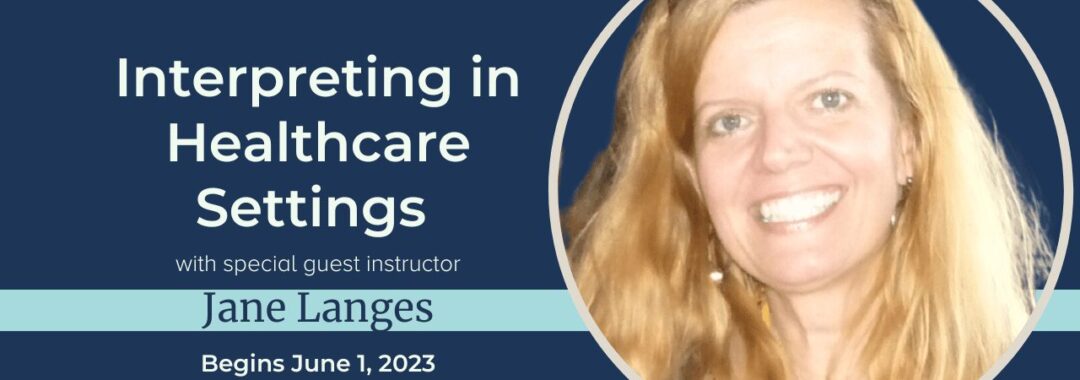
Interpreting in Healthcare Settings Starts June 1
As a practicing interpreter, you understand how important it is for individuals to be able to connect with service providers, such as doctors, social workers, lawyers, and others. Interpreting requires more than just speaking two languages. An interpreter’s role requires strong communication skills and awareness, research competency, a solid understanding of roles and protocols, and so on. Clear communication is essential to providing effective and safe care.
In Canada, an important aspect of ensuring equitable access to healthcare includes providing language interpreting services for patients with limited English proficiency or who are deaf or hearing impaired.
Interpreters working in American Sign Language or in Arabic, Punjabi, Mandarin, or a host of many other languages, provide important support access for individual patients, as well as help maintain a high level of quality for the healthcare system overall. Interpreters trained specifically in health care interpreting are imbued with the necessary skills to provide high-quality interpretation services in healthcare settings. Effective communication is essential to ensure that patients receive appropriate care, as any miscommunication due to language barriers or cultural differences can have serious consequences.
Guest Instructor
Jane Langes is the Executive Director and ASL / English Interpreter at E-Quality Communication Centre of Excellence (ECCOE) and an interpreter educator. She has been a sign language interpreter for over 30 year and has been training spoken language interpreters for the Province of Manitoba for over 17 years, supporting training programs for healthcare at hospitals and clinics, community services, social services, and advanced training for both legal and educational interpreting.
By providing training through The Interpreter’s Lab, Jane will be assisting with spoken language interpreter training in BC, for the first time. We are excited to have Jane’s expertise available through this valuable training program.
For more information about the Interpreting in Healthcare training at TIL, click here.
What will you learn from this course?
1
Interpreting in Healthcare emphasizes the importance of patient confidentiality and ethical considerations. Interpreters who work in healthcare settings often have access to sensitive medical information, and it is essential that they understand their ethical obligations to maintain patient confidentiality. The training can help interpreters to understand their ethical responsibilities and to develop strategies for maintaining patient confidentiality in a healthcare context.
2
Training covers topics such as cultural competency and cultural sensitivity, which can help interpreters understand how cultural factors can influence healthcare experiences and outcomes. This understanding can help interpreters to better support patients from diverse cultural backgrounds and ensure that their healthcare needs are met.
3
Interpreting in Healthcare training also helps interpreters to understand the professional standards of practice for healthcare interpreters. This includes understanding the importance of accuracy, impartiality, and confidentiality in interpretation, as well as the importance of ongoing professional development. By understanding these standards of practice, interpreters can ensure that they are providing high-quality interpretation services that meet the needs of patients and healthcare providers.
Join Jane Langes and help improve language access for all. Take part in The Interpreter’s Lab training program and become a skilled interpreter equipped to bridge communication gaps and ensure effective and safe care for all patients.
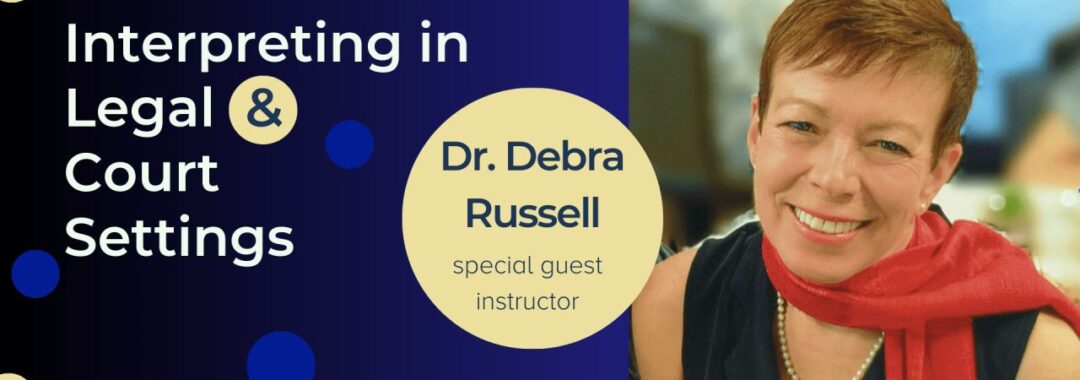
Legal and Court Interpreter Training Program with Dr. Russell
Interpreting in court and legal settings is a highly specialized field that requires a unique set of skills and knowledge. Legal interpreting involves interpreting for a wide range of legal proceedings, including depositions, trials, hearings, and other legal proceedings. It requires a deep understanding of legal terminology, legal procedures, and cultural differences that can affect communication.
Dr. Debra Russell is a sign language interpreter (ASL/English) but conducts research and teaches also for spoken languages. Dr. Russell was TIL’s 2023 kick-off guest speaker for the January Professional Development Speakers Series (The Function of Questioning in Legal Settings) and spoke to the need for a specialized skill set to work in legal and court settings. The workshop gave us an overview of the complexities involved in working in these formal and important environments. Now, Dr. Russell will join us once again as this year’s guest educator for TIL’s Interpreting in Legal and Court Settings – starting May 2.
As a Canadian certified interpreter, educator, and researcher with a practice spanning over 30 years, Dr. Russell has focussed much of her research and work in the legal sphere, as both an interpreter and educator. We asked Dr. Russell why specialized training is necessary.
Watch Dr. Russell’s response at The Interpreter’s Lab site HERE
Training in legal interpreting can open a world of opportunities for interpreters. Specialized training for legal interpreting ensures that interpreters have the knowledge and skills necessary to provide accurate and effective interpreting services. Legal proceedings can be complex and nuanced; the consequences of misunderstandings can be significant. As interpreters explore new areas of work, expanding beyond healthcare and other public sector services, it is important to advance by building a solid set of skills that will enhance their existing expertise and experience.
Legal proceedings can be intimidating for anyone, and without an informed understanding of protocols that govern the interactions in a courtroom or court-like setting (e.g., administrative tribunals, examinations for discovery, etc.), even a practiced interpreter can become overwhelmed and anxious. Specialized training in legal interpreting facilitates the interpreter’s contextual knowledge and allows them to better understand and navigate the legal system in which they are working.
Skilled and trained legal interpreters work with law firms, all levels of local, provincial and federal courts, administrative tribunals and other legal establishments, and can command higher rates of pay.
If you’re an interpreter who wants to take your skills to the next level, consider investing in specialized training in legal interpreting. This is a wonderful opportunity to work with one of Canada’s most respected and eminent educators.
Registration for Interpreting in Legal and Court Settings closes April 22, 2023.
Find out more and register by CLICKING here
Debra Russell, PhD, is a Canadian certified interpreter, educator, and researcher. Her interpreting practice spans over thirty years. Her interpreting focus is medical, legal, mental health and employment settings. She has had a long history of leadership positions at the local, national, and international level, serving on several volunteer organizations. She is the Past President of the World Association of Sign Language Interpreters (WASLI).
Dr. Russell is extensively published in the field of interpretation, including as the co-author of Interpreting in Legal Settings and the author of Interpreting in Legal Contexts: Consecutive and Simultaneous Interpretation.
She continues to teach both spoken language and sign language interpreters. She loves to travel and has presented in over 64 countries.
Dr. D Russell: Interpreting Strategies in Legal Discourse
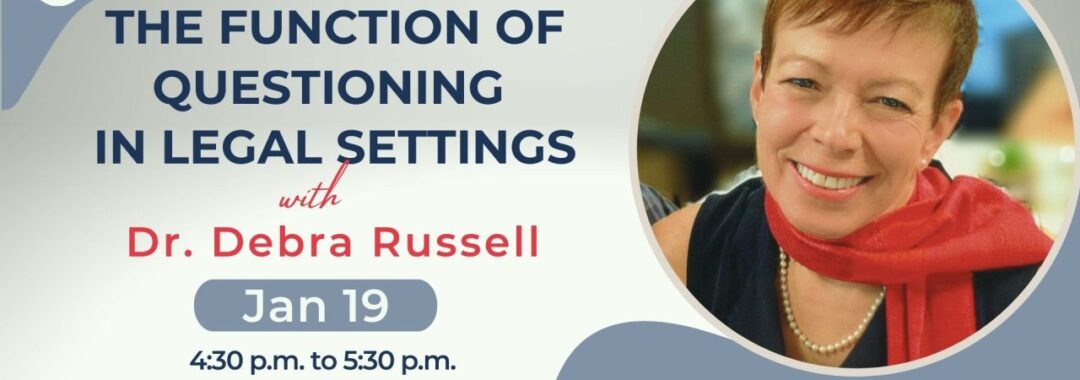
Professional Development Speaker Series 2023 Launches January 19
Dr. Debra Russell to Launch The Interpreter’s Lab 2023 Professional Development Series.
The Interpreter’s Lab is honoured to have Dr. Debra Russell as the first presenter for this year’s Professional Development Speaker Series. With over 30 years of experience in the interpreting field working as an ASL interpreter, interpreter educator, and consultant, our esteemed colleague, Dr. Russel, will be leading an important session on The Role of Questioning in Legal Settings. Join us on Thursday, January 19th. It is not too late to register.
Dr. Russell’s session will cover the different questioning techniques employed in legal settings and courtrooms, highlighting their importance and modes of application while guiding us in exploring the different techniques that are deliberately and professionally employed. Interpreters working in legal, court, and law enforcement settings will benefit from learning the intent behind the questions, so that they can accurately interpret the message.
If you cannot attend this professional development session, but want to learn more about how to successfully and professionally work in legal, court and law enforcement settings, we encourage you to enroll in the Interpreting in Court and Legal Settings training course. Dr. Russell will be our guest instructor this year – with over 30 years experience as an interpreter, researcher, and interpreter educator as well as her expertise in legal settings – her teaching is sure to give you an incredible foundation as a legal and court interpreter. Interpreting in Court and Legal Settings starts May 2, 2023.
You can register for this, and any upcoming sessions offered by The Interpreter’s Lab, on our website. Our Professional Development Sessions are a monthly feature, designed to further your education by introducing an expertly curated list of topics presented by different speakers who are experts in their respective fields. They can be attended as monthly stand alone sessions, or in tandem with our Interpreter Training classes, which provide in depth interpreting knowledge in legal, healthcare and community settings.
Further information about the classes we offer can also be found on the Interpreter’s Lab website.

Multilingualism on the Pitch
Multilingualism and FIFA
With FIFA currently in our sights, I started wondering just how the communication flows between all the players, on and off the field. Have you ever wondered what language all those players and referees are speaking to each other on the pitch? How do they all communicate without interpreters in the mix?
FIFA is host to 32 different countries speaking up to 20 different languages, so it makes sense to wonder if there have been any negative outcomes due to miscommunication, especially because we do not see any interpreters running around on the field with them. Multilingual Magazine recently wrote on this very topic and, as can be expected with all things intercultural and multilingual, errors have occurred.
“On Sunday, South Korea’s head coach Paulo Bento spoke to reporters about the status of two injured players, Kim Min-jae and Hwang Hee-chan. Korean-speaking spectators were disappointed to hear that both players would be sitting out at the next day’s match against Ghana, but it turns out the misunderstanding was the result of an erroneous interpretation.
Speaking in his native Portuguese, Bento said that he would make a game-day decision about whether or not Kim could play, and that Hwang would sit out the next day’s match. The Korean interpretation, however, led audience members to believe that neither player would be able to participate in the following game.
According to a report from The Korea Times, the Korean Football Association filed an official complaint with FIFA over the error the next day. FIFA claims to be taking steps toward ensuring that future incidents like this do not occur.”
Well, it will be interesting to see just what steps FIFA will take to mitigate these errors in communication. Read the full article here.
And Yahoo news says that English has become the de-facto language of choice, not only for FIFA but also, it seems, the Olympics, where English has usurped French as the go-to language. This Yahoo News Story also shares another incident of alleged miscommunication, between a Japanese referee and a Croatian player.

Giving Tuesday
Giving Tuesday is a generosity movement with core values rooted in selflessness. It seeks to support and give to the community around us, and globally with the help of the Giving Tuesday Organization. The first Giving Tuesday took place in 2012, as a response to the rampant self-driven consumerism surrounding Black Friday, and the subsequent Cyber Monday.
Recent price increases have made me stop and think about where it is I want to put my money, and if I really need all the things I think I need. This reflection, caused by external factors, has been a very positive thing. As I reflect on all that I do have instead of what I don’t, I find myself more connected to the Giving Tuesday movement, and the morals it has.
Happiness is cultivated from within. Loving, kindness, gratitude and sharing are all acts that give us far more joy than consumerism and fad purchases, while building character and showing us what happiness truly is. Times are tough right now, and I am in no way trying to understate that reality. In this difficult period, many of us find ourselves purchasing small gifts and things as a reward for the financial, emotional and multitude of other hardships that we work through every day.
Generosity brings happiness at every stage of its expression. We experience joy in forming the intention to be generous. We experience joy in the actual act of giving something. And we experience joy in remembering the fact that we have given.
GAUTMA BUDDHA
Changing the way you shop, and the ways in which you reward yourself is not an easy feat, nor one that will occur overnight. But supporting the people around you, as well as those you do not know, can fundamentally change the reality for all of us.
Black Friday, Cyber Monday, and Giving Tuesday all take place in the span of 5 days. On Friday we are encouraged to buy, to race to the deals, to get what we can at the lowest price. Cyber Monday is an extension of that, with deals being featured online, inciting people to continue shopping and spending. Giving Tuesday instead asks us to look at what it is that we can give, what we can share. It can be a small kindness, or a larger gift. The size does not matter, what does is the intention behind the act. Do not give to fulfill a quota but give because you care.
In honour of Giving Tuesday, The Interpreter’s Lab will be donating one full Premier Membership* to be drawn on December 15th. And for our current Premier Members, we will give an additional 20% discount (in addition to the current membership benefit of 15% discount) on any current or upcoming course – for 35% off course fees ($350 savings)**.
Both prizes will be drawn on Thursday, December 15th.
We are also instituting the gift of Premier Membership as a Giving Tuesday annual event.
If you are interested in submitting your name for the draw, please complete this form and your name will be entered. We will contact you via email.
*Note that you must not currently be a member to be eligible for this Membership Gift.